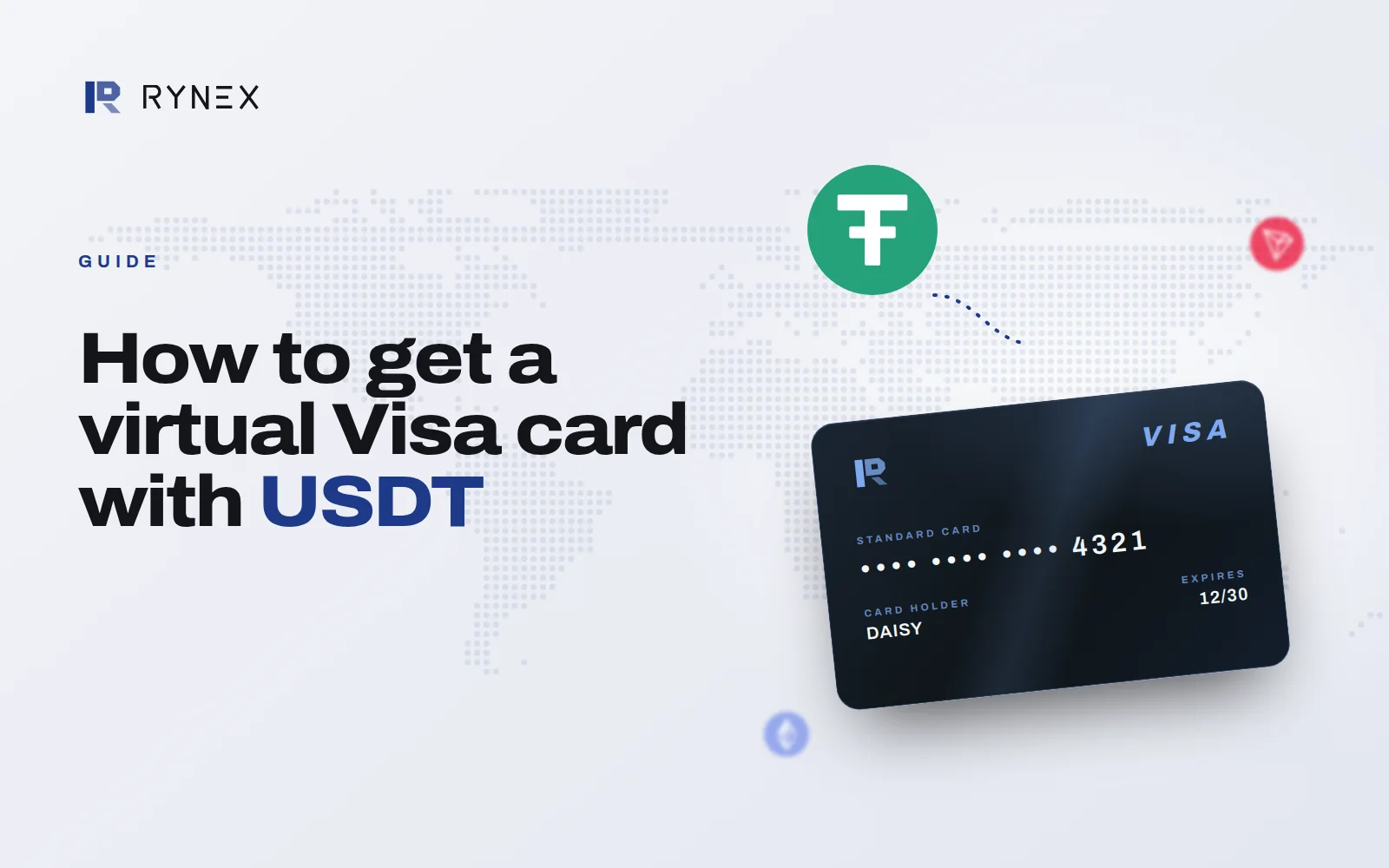
If you hold crypto, you have probably come across USDT. It is the coin Rynex cards are funded with. Here is what it is, and why it suits a card.
A dollar, on a blockchain
USDT, also called Tether, is a stablecoin: a digital token designed to keep the same value as the US dollar. One USDT aims to be worth one dollar.
That makes it different from coins like Bitcoin or Ether, whose price moves up and down every day. With USDT, the amount you send is the amount you meant to send.
Why it suits a card
A Visa card spends in dollars, so it helps to fund it with something that holds a dollar's value:
- What you send is what you get. There is no price swing between sending your deposit and the card being created.
- It is everywhere. Most wallets and exchanges hold USDT and let you send it.
- It moves fast. Once your deposit reaches the network, your card is created by itself. There is no bank transfer to wait on.
One coin, several networks
USDT exists on several blockchains, called networks. Rynex accepts it on nine: Tron, Ethereum, BNB Smart Chain, Solana, Polygon, Arbitrum, Optimism, Avalanche and Plasma. The deposit screen shows them all.
Each deposit address is made for one coin on one network, and both are shown beside it. When you send:
- Choose the network on the deposit screen.
- Send USDT on that same network from your wallet or exchange.
Sending on another network, or sending a different token, loses the money for good. Check both before you confirm.
If you send from an exchange, it takes its own withdrawal fee before the money leaves, so send enough for the full amount to arrive. The deposit screen tells you how much must arrive.
What about other coins?
A Rynex card is funded with USDT only. If you hold Bitcoin, Ether or another coin, swap it for USDT in your wallet or exchange first, then send that.
Ready to try it?
Create your account, choose a card, and send USDT. Your card goes live the moment it lands. For the full walk-through, read how to get a virtual Visa card with USDT.