You hold USDT. The services you pay for every month, a streaming service, an AI assistant, cloud storage, a design tool, almost all want a card. Very few of them take crypto at checkout, and the ones that do often add steps of their own.
A virtual Visa card funded with USDT closes that gap. The service sees an ordinary Visa card. You fund it from your wallet.
How it works
- Create a card in your Rynex dashboard and name it after the service, so you can find it again.
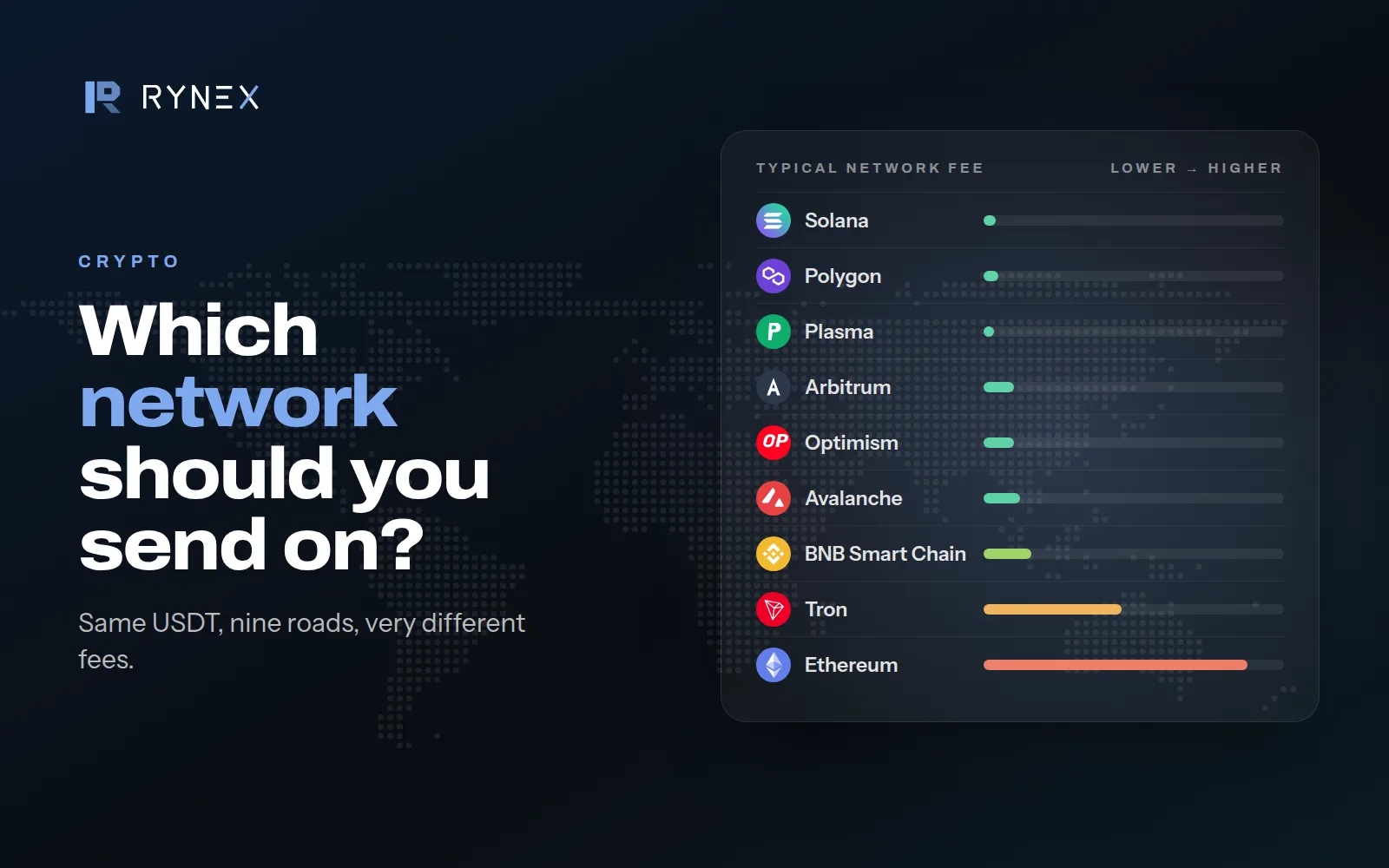
- Fund it with USDT on any of the nine networks we accept. The deposit screen shows exactly how much must arrive, with the fee included.
- Enter the card at the service's checkout: the number, expiry date and CVV from your dashboard, and the billing address shown with the card.
- Top it up before the renewal if the balance is getting low. A standard card can be topped up whenever you need.
The full walk-through is in how to get a virtual Visa card with USDT.
Why one card per service
You can put every subscription on a single card. You get more control by giving each service its own.
- Cancelling is closing a card. If a service makes leaving hard, close or freeze its card and the next charge is declined.
- A free trial can't quietly turn into a charge. Put the trial on its own card and freeze it before the trial ends, and the first paid month is declined.
- A price rise can't run away with you. The card spends only its balance. There is no overdraft and no credit.
- You see what each service really costs, because each card has its own list of payments.
There is more on this approach in one card for every subscription.
Things worth knowing
Most merchants take it, but not every one
A Rynex card works at most merchants that accept Visa. Some services decline prepaid or virtual cards as a matter of policy, and we can't change that. If a checkout refuses the card, that service is likely one of them. Better to know before you fund a card for it: start with a small balance.
Use the billing address shown with the card
Many checkouts compare the address you type with the one on file for the card. Use the billing address from your dashboard, exactly as shown. Copy all copies it in one go.
Where the service bills from changes the fee
A payment to a merchant in the United States has no cross-border fee. A payment to a merchant outside the US does. Many large subscription services bill from the US, but not all of them, and the merchant's location decides it, not yours. Every figure is on the pricing page.
Keep enough on the card for the renewal
If the balance is short on renewal day, the payment is declined, and the service may pause your account until it is paid. Check the renewal date, and top up a few days ahead.
Which card to use
For a subscription you'll keep, use a standard card: you can top it up whenever the next payment is due. A lite card is funded once and can't be topped up later, so it suits a single month or a one-off purchase. Here is how the two compare.
Ready to try it?
Create your account, make a card for the first service on your list, and fund it with USDT. If you're not sure which network to send on, read which USDT network you should send on.