USDT is the same coin whichever network it travels on. One USDT on Tron is worth one USDT on Solana. What changes is the road: how much it costs to send, how fast it arrives, and which wallets and exchanges support it.
Rynex takes USDT on nine networks: Tron, Ethereum, BNB Smart Chain, Solana, Polygon, Arbitrum, Optimism, Avalanche and Plasma. Here is how to choose between them.
Two fees, not one
When you send USDT, you can pay two separate fees.
- The network fee. Every blockchain charges a small fee to process a transfer. It is usually paid in that network's own coin: TRX on Tron, ETH on Ethereum, SOL on Solana, and so on. If your wallet holds USDT but none of that coin, the transfer will not go through.
- The exchange's withdrawal fee. If you send from an exchange, it sets its own fee for each network, and it takes that fee out of what you send. This is often larger than the network fee itself, and it differs from one exchange to the next.
So the cheapest network on paper is not always the cheapest for you. Before you send from an exchange, open its withdrawal screen, pick USDT, and look at the fee it shows beside each network. That number is the one you will actually pay.
The networks, side by side
Network fees move with demand and with the price of each network's coin, so treat these as rough, usual ranges rather than quotes.
- Solana. Usually a fraction of a cent, and fast: a few seconds. One of the cheapest roads there is.
- Polygon. Usually well under a cent. Fast and widely supported.
- Arbitrum and Optimism. These run on top of Ethereum and cost far less than it: usually a few cents or less, settling in seconds.
- Avalanche. Usually a few cents or less, and fast.
- BNB Smart Chain. Usually around a few cents. Widely supported, especially on Binance.
- Tron. The most common network for USDT. The fee depends on whether the sender has "energy", Tron's own resource for paying fees. Without it, a transfer usually costs a couple of dollars' worth of TRX, and more when the receiving address has never held USDT before. Wallets that rent or stake energy can bring that close to zero.
- Ethereum. The original home of USDT, and the most expensive. A transfer usually costs from under a dollar on a quiet day to several dollars, and can cost far more when the network is busy.
- Plasma. A newer network built for stablecoins. Simple USDT transfers can be free, with the fee paid by the network itself, within limits on how many you send. Check that your wallet or exchange supports it.
How to choose
- Sending from an exchange? Pick the network with the lowest withdrawal fee on that exchange's own screen. That is usually the whole decision.
- Sending from your own wallet? Use a network where you already hold USDT and a little of the coin that pays the fee. Moving USDT between networks first costs more than it saves.
- Sending a small amount? Avoid Ethereum: a fee of a few dollars is a large share of $20.
- Not sure? Solana, Polygon and the Ethereum layers like Arbitrum and Optimism are cheap and quick for most people.
The rule that matters more than the fee
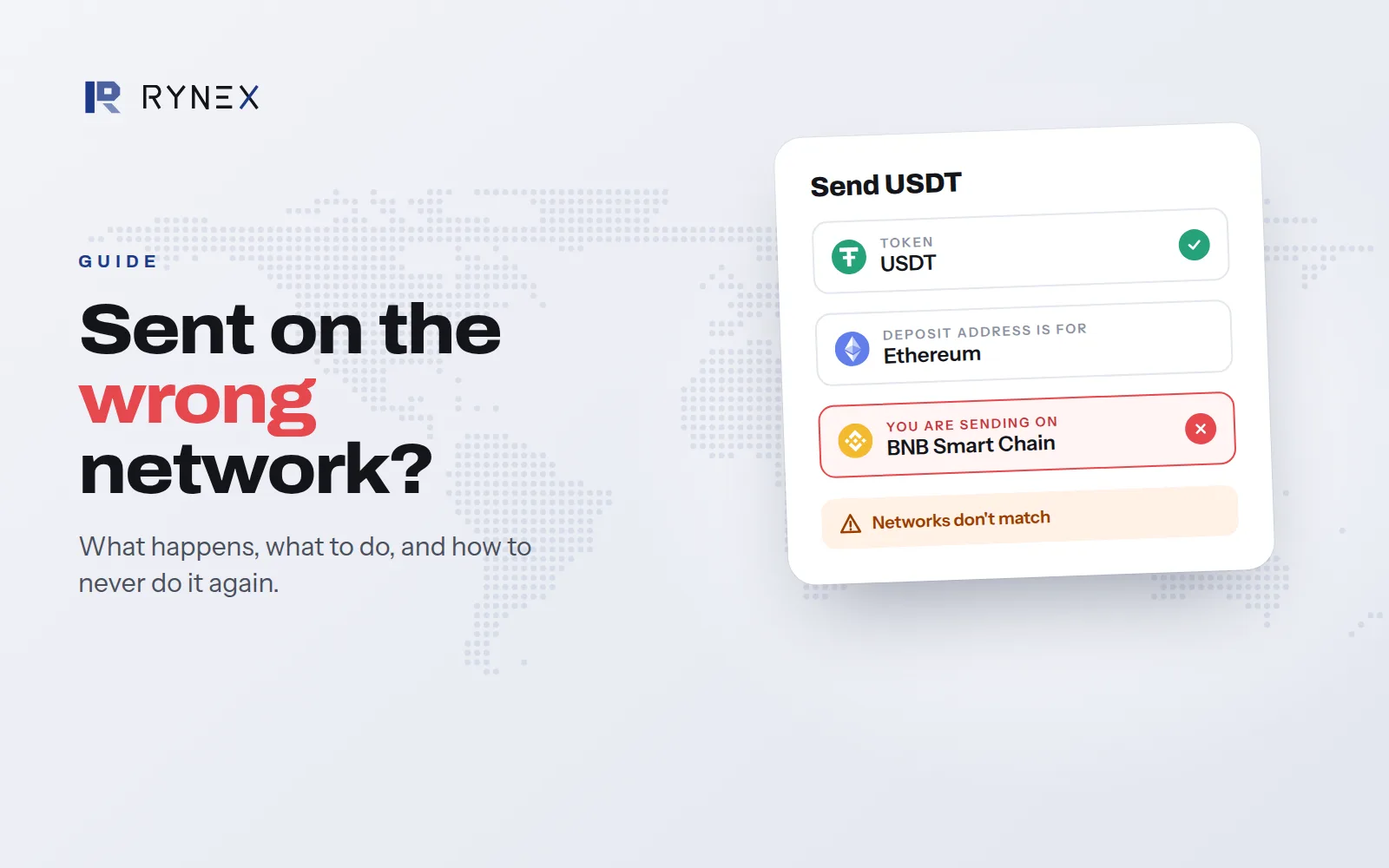
Whichever network you pick, the sender and the receiver must use the same one. Each Rynex deposit address is made for one coin on one network, and both are shown beside it.
USDT sent on a different network from the one shown, or any token other than USDT, cannot be credited and is usually lost for good. If that happens, read what to do if you sent USDT on the wrong network.
Choose the network on the Rynex deposit screen first, then choose the same network in your wallet or exchange. The deposit screen also tells you exactly how much must arrive, so if your exchange takes its fee out of the amount, send a little more to cover it.
Ready to send?
New to USDT? Start with what USDT is, and why fund a card with it. Rynex's own fees are on the pricing page. When you're ready, create your card.